If your doctor, your partner or your own exhaustion is telling you to get a sleep study, the next question is usually: can I just do this at home? Sometimes the answer is yes. Often, an overnight study in a sleep lab gives a clearer answer. Here is how the two tests compare and how to decide.
What a home sleep test measures
A home sleep test (HST) is a small device you wear in your own bed for one or more nights. It typically records breathing, airflow, chest movement, oxygen levels and heart rate. It is designed for one main job: checking for obstructive sleep apnea in adults who are likely to have it.
Home tests are convenient, but they have limits. Most do not measure brain activity, so they cannot tell exactly how long or how deeply you slept. They can underestimate mild sleep apnea, and they cannot diagnose other sleep disorders.
What an in-lab sleep study measures
An in-lab study, called polysomnography, records brain waves, eye movements, muscle activity, breathing, oxygen, heart rhythm and leg movements through the night, with a trained technologist monitoring you. That fuller picture is why it is considered the most complete sleep test.
When an in-lab study is usually the better choice
- You may have narcolepsy or severe daytime sleepiness (an overnight study is followed by a daytime MSLT)
- You act out dreams, sleepwalk or have other parasomnias
- You have frequent leg movements or restless legs that disrupt sleep
- You have significant heart or lung disease, or other conditions that make home testing less reliable
- A home test was negative or unclear, but symptoms continue
- You need CPAP adjusted, which is done in a CPAP titration study
When a home sleep test may be enough
If you are an adult with classic signs of sleep apnea, such as loud snoring, pauses in breathing and daytime sleepiness, and no other major health or sleep concerns, a home test can be a reasonable first step. Your physician will help decide.
How Dream Sleep Centre handles both
We run overnight sleep labs in Oceanside and Hillcrest, San Diego, open nightly. When a home sleep test is the better fit, we refer it to the testing company we work with, and we can manage the scheduling or the referral for you, so you are not left to sort it out alone.
Every study at Dream Sleep Centre is read and interpreted by our physicians, Dr. Nevin Arora, MD, our Medical Director, and Dr. Pegah Mashayekhi, DO, who is board certified in Sleep Medicine. They review your results with you, prescribe treatment and follow your progress.
What an in-lab night is like
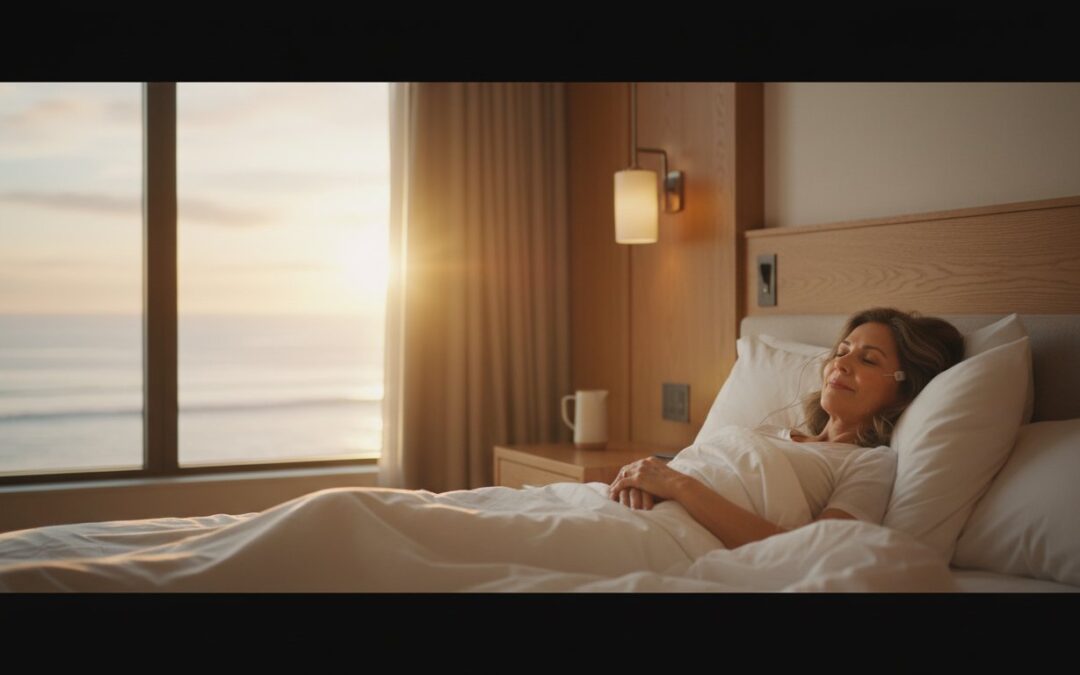
Many people picture a hospital ward. Our labs feel more like a boutique hotel, with modern decor, free Wi-Fi and Netflix on the TV. Bring comfortable pajamas and a book, and settle in. Appointments are often available in as little as 2 weeks, and no referral is needed to book.
Quick answers
Is a home sleep test as accurate as an in-lab study? For moderate to severe sleep apnea in otherwise healthy adults, home tests work well. For milder cases and other sleep disorders, an in-lab study is more complete.
Does insurance cover sleep studies? Coverage depends on your plan. We are in network with Aetna, Cigna, Kaiser Permanente, TRICARE and TriWest, and work with PPO plans that include out-of-network benefits. Call us at (858) 755-1166 to check your benefits.
Related care at Dream Sleep Centre
- Sleep study FAQ
- Sleep apnea care
- What happens during an overnight sleep study
- Meet our sleep physicians
- Overnight sleep labs in Oceanside and Hillcrest, San Diego
- Insurance we accept
Book a sleep evaluation or call (858) 755-1166. No referral required.