
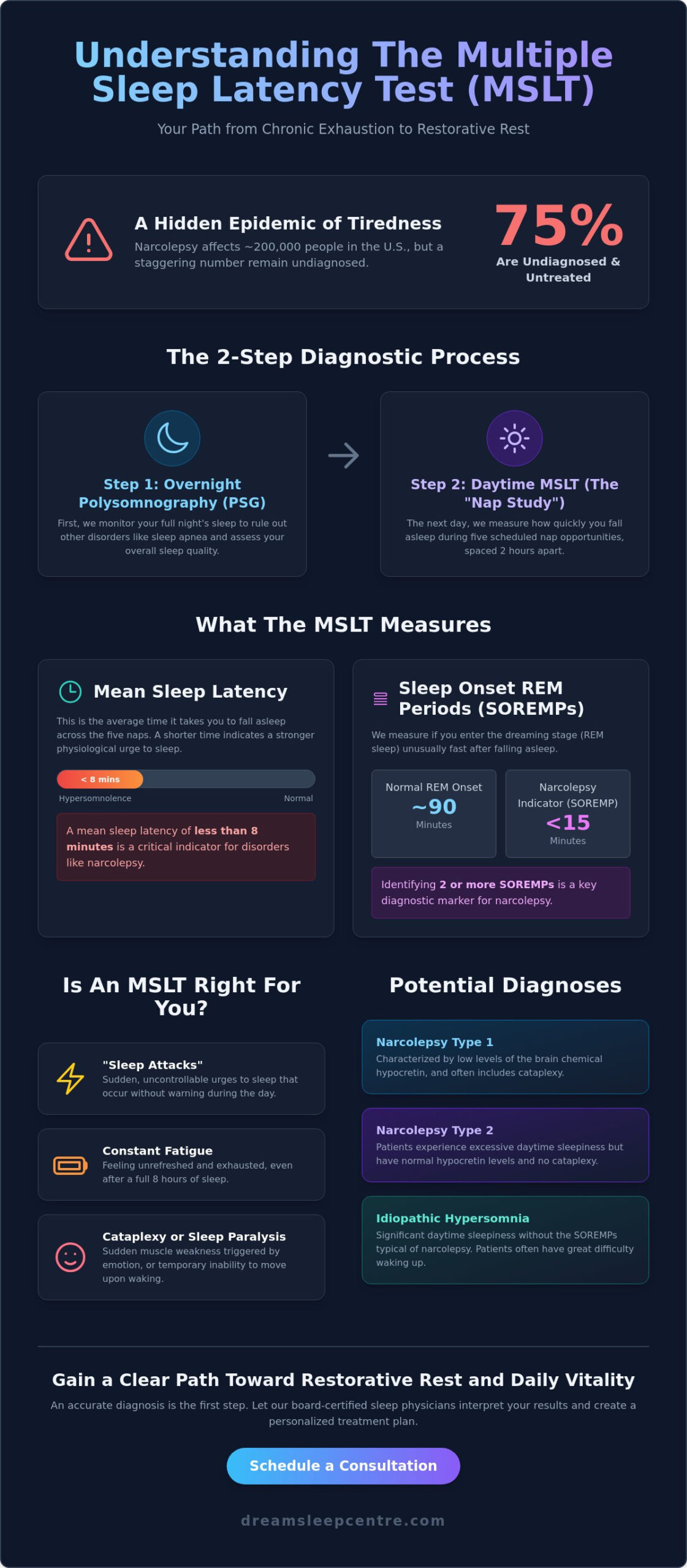
Did you know that narcolepsy affects approximately 200,000 people in the United States, yet only about 25% of those individuals are actually diagnosed and treated? If you find yourself fighting uncontrollable urges to sleep while navigating San Diego traffic or struggling with persistent brain fog, you aren’t just “tired.” You may be dealing with a complex sleep disorder that requires specialized clinical attention. At Dream Sleep Centre, our office provides comprehensive mslt testing san diego to help you uncover the precise cause of your excessive daytime sleepiness.
We understand how isolating it feels when a full night of sleep doesn’t result in a refreshed morning. It’s frustrating to live in a state of constant fatigue, but you don’t have to navigate this journey alone. This guide will walk you through exactly what to expect during a Multiple Sleep Latency Test, from the 2021 AASM protocol updates to the specific steps our team takes to ensure your comfort. You’ll learn how this precision diagnostic tool serves as a vital bridge between chronic exhaustion and the restorative rest you deserve.
Key Takeaways
- Learn how the Multiple Sleep Latency Test measures your body’s physiological urge to sleep in a quiet, clinical environment.
- Discover how our office uses specific nap patterns to differentiate between Narcolepsy Type 1, Type 2, and Idiopathic Hypersomnia.
- Understand the logistics of mslt testing san diego, including the transition from an overnight study to five scheduled daytime nap opportunities.
- Identify why a mean sleep latency of less than eight minutes is a critical indicator for sleep-related disorders.
- Gain a clear path toward restorative rest and daily vitality by understanding how board-certified sleep physicians interpret your results.
What is an MSLT Test? Understanding the ‘Nap Study’
Finding the root cause of exhaustion requires more than just a conversation; it requires precise data. The Multiple Sleep Latency Test, or MSLT, is the clinical standard for measuring how quickly you fall asleep in a quiet environment during the day. When you schedule mslt testing san diego at our office, we focus specifically on your sleep latency. Sleep latency is the time elapsed from the start of a nap opportunity to the first signs of sleep.
This study is the gold standard because it removes the guesswork from diagnosing excessive daytime sleepiness. While you might feel like you’re always tired, the MSLT provides our board-certified physicians with objective evidence of your body’s neurological drive to sleep. It transforms your subjective experience into a measurable clinical record that we use to build your personalized care plan.
To better understand how this diagnostic tool works, watch this helpful overview:
MSLT vs. Polysomnography: What is the Difference?
You’ll typically complete this study immediately following an overnight polysomnography (PSG). While the PSG monitors the quality and architecture of your rest at night, the MSLT monitors your tendency to fall asleep during waking hours. Our office performs these tests back-to-back to ensure that your daytime sleepiness isn’t simply the result of a single poor night’s rest or undiagnosed sleep apnea. This sequence is essential for a valid and accurate diagnosis.
Measuring REM Sleep Onset
A unique feature of the MSLT is its ability to track brain waves to identify Sleep Onset REM Periods (SOREMPs). Most people take about 90 minutes to reach the dreaming stage; however, those with certain conditions might skip straight to REM sleep within minutes. Tracking these transitions through sensors on the scalp and near the eyes helps our team pinpoint specific neurological sleep disorders with high precision. By identifying these patterns, we can help you move from feeling drained to feeling refreshed.
Key Symptoms and Conditions Diagnosed via MSLT Testing
While many patients describe a “tired but wired” sensation, this persistent state of exhaustion often indicates a deeper neurological issue. If your routine is disrupted by sudden, uncontrollable urges to sleep, mslt testing san diego at our office provides the necessary diagnostic clarity. We utilize this daytime nap study to differentiate between various central disorders of hypersomnolence that an overnight study alone might miss.
A critical component of this process is the relationship between your overnight results and your daytime performance. We must first ensure that your fatigue isn’t a byproduct of fragmented sleep architecture or obstructive sleep apnea. If your nocturnal study shows healthy sleep but the MSLT reveals you fall into deep sleep within minutes during the day, we can accurately diagnose Narcolepsy Type 1, Narcolepsy Type 2, or Idiopathic Hypersomnia. This distinction is vital because the treatment path for each condition differs significantly.
Signs You May Need an MSLT in San Diego
If you’re struggling to maintain alertness during your daily activities, look for these specific indicators:
- Experiencing “sleep attacks” that occur without warning during your most productive hours.
- Feeling unrefreshed despite getting a full eight hours of rest.
- Noticing narcolepsy symptoms such as cataplexy or temporary sleep paralysis upon waking.
Occupational Safety and MSLT
For San Diego’s transportation professionals and pilots, diagnostic accuracy is a matter of both safety and career longevity. California regulations often require objective verification of wakefulness to maintain professional licensure. Our office provides the rigorous clinical evidence needed for these evaluations. If your livelihood depends on your ability to remain alert, you can schedule a consult with our team to discuss your specific testing requirements. We’re here to help you regain your vitality and protect your professional future.
Your Day at Dream Sleep Centre: The MSLT Process
The transition from your nocturnal study to daytime testing is seamless. Your journey with mslt testing san diego begins approximately 1.5 to 3 hours after you wake from your overnight polysomnography. Because we already established a baseline of your sleep quality during the night, our technicians keep the sensors attached to your scalp and chest. This allows us to continuously monitor your brain activity and heart rate without the need for a second, time-consuming setup process in the morning.
We’ve designed our San Diego facility to feel like a boutique hotel rather than a traditional clinic. A quiet, comfortable environment is essential because stress can artificially mask sleepiness. Throughout the day, you’ll be given five specific nap opportunities scheduled exactly two hours apart. During each 20-minute window, our team observes how your brain transitions into sleep, providing the objective data needed to understand your chronic fatigue.
Between the Naps: Staying Awake
The time between your scheduled naps is just as important as the naps themselves. You must remain awake during these two-hour intervals to ensure the data remains valid. We recommend bringing books, a laptop, or other quiet hobbies to keep you occupied in your private room. To protect the integrity of the study, you must avoid caffeine, nicotine, and strenuous physical exertion until all five trials are complete.
Preparing for Your Visit
Preparation for a successful study starts at home. You may need to taper off certain medications under physician supervision for at least 14 days prior to your arrival. For a complete checklist of what to pack and how to manage your routine, please refer to our guide on how to prepare for your MSLT in San Diego. If you’re ready to find a path toward vitality, contact Dream Sleep Centre today to begin your diagnostic process.
Interpreting Results and Finding a Path to Vitality
After completing your mslt testing san diego, our board-certified sleep physicians begin a meticulous analysis of your data. We don’t just look at how fast you fell asleep; we examine the specific architecture of those naps. If your mean sleep latency is less than 8 minutes across your five nap opportunities, it often indicates a significant sleep disorder. Given that only 25% of the 200,000 Americans living with narcolepsy are currently diagnosed, this objective data is your most powerful tool for finally securing an accurate diagnosis and moving toward a refreshed life.
This data becomes much more powerful when we link it to your polysomnography San Diego findings. By viewing your overnight rest and daytime sleepiness as a single, holistic picture, our office can rule out external factors like sleep apnea. This comprehensive approach ensures your diagnosis is accurate and your path to vitality is clear. We focus on the human benefit of these results, helping you transition from a state of exhaustion to one of renewed energy.
Customized Treatment Plans at Dream Sleep Centre
Once we have a definitive diagnosis, our office focuses on non-surgical, personalized care. We guide you through medication management designed for wakefulness or REM suppression, depending on your specific neurological needs. We also help you implement lifestyle adjustments, such as scheduled napping strategies that align with your body’s natural rhythms. Integrating behavioral health support often provides the final piece of the puzzle for long-term wellness and professional performance.
Next Steps: Scheduling Your Consultation
If you struggle with uncontrollable daytime sleepiness or brain fog that impacts your daily life in San Diego, you don’t have to wait for answers. Our team is dedicated to helping you reclaim your focus and safety. Contact Dream Sleep Centre today at (858) 294-0402 to discuss your symptoms and schedule your consult at one of our convenient locations. We’re ready to help you rediscover the vitality that comes from truly restorative rest.
Reclaim Your Energy and Daily Focus
Living with chronic exhaustion is more than just a lifestyle hurdle; it’s a physiological challenge that impacts your safety and professional success. By choosing mslt testing san diego, you’re taking a definitive step toward identifying the neurological root of your fatigue. Our physician-led team, directed by Dr. Ramadevi Arani, specializes in uncovering conditions like narcolepsy and idiopathic hypersomnia through objective data rather than guesswork. You’ll experience this diagnostic process in our boutique, hotel-like labs that prioritize your comfort and peace of mind.
Once your results are interpreted, we provide comprehensive non-surgical sleep solutions tailored to your unique biology. Whether you need lifestyle adjustments or clinical wakefulness management, we’re here to guide you back to a life of vitality. If you are struggling with excessive daytime sleepiness, contact Dream Sleep Centre at (858) 750-2309 to schedule your diagnostic evaluation. Don’t let another day pass in a fog when professional, empathetic care is within your reach. Your path to refreshing, restorative rest begins with a single phone call.
Frequently Asked Questions
How long does an MSLT test take to complete?
Your MSLT will typically take between 8 and 10 hours to complete after your overnight study ends. The protocol involves five separate nap opportunities, each occurring at 2-hour intervals throughout the day. Because the first nap usually begins about 1.5 to 3 hours after you wake up from your nocturnal study, you should plan to spend the full day at our office to ensure we capture a complete data set.
Can I drink coffee or tea on the day of my MSLT?
You cannot consume coffee, tea, or any caffeinated products on the day of your testing. Caffeine acts as a stimulant that can significantly alter your sleep latency and interfere with the accuracy of the results. To maintain a clean diagnostic baseline, you must also avoid nicotine and heavy physical activity. These restrictions are necessary to ensure the brain wave data we collect reflects your natural physiological state.
What happens if I cannot fall asleep during one of the naps?
If you’re unable to fall asleep during a specific trial, the nap opportunity will end after 20 minutes. This outcome is recorded as part of your overall study and doesn’t mean the test has failed. Our physicians calculate the mean sleep latency by averaging the results of all five naps. Even a ‘no sleep’ result provides critical information about your alertness levels and neurological sleep drive.
Is an MSLT test covered by insurance in San Diego?
Most private insurance providers and Medicare cover mslt testing san diego when it’s medically necessary to diagnose a sleep disorder. While national costs for this procedure can range from $600 to $2,200 according to a March 2025 industry report, your personal expense depends on your specific plan. We suggest contacting your insurance carrier to confirm your deductible and co-insurance obligations before your scheduled visit to our office.
Do I need to stay at the sleep center between naps?
You’re required to remain at the sleep center for the full duration of the daytime study. Leaving the facility between naps could compromise the test results by exposing you to stimulants or allowing unscheduled sleep to occur. Our San Diego office offers a quiet, boutique setting where you can use your laptop or read between trials. This controlled environment ensures the integrity of your mslt testing san diego remains intact.
Disclaimer
The information provided by Dream Sleep Centre is for educational and informational purposes only and does not constitute medical advice, diagnosis, or treatment. Always seek the advice of your physician or other qualified health provider with any questions you may have regarding a medical condition or sleep disorder. Never disregard professional medical advice or delay in seeking it because of something you have read on this website. Reliance on any information provided here is solely at your own risk.