

Imagine you’re navigating the heavy afternoon traffic on the I-5 freeway when an overwhelming, uncontrollable wave of sleepiness hits. It isn’t just the typical mid-day slump. It’s a profound neurological weight that makes your eyes heavy and your limbs feel like lead. For many San Diegans, this isn’t a rare occurrence but a daily reality caused by narcolepsy. You’ve likely spent months wondering if you’re simply overworked or if something deeper is happening within your brain’s sleep-wake regulation.
We understand that living with sudden muscle weakness or the fear of falling asleep in public is both exhausting and emotionally taxing. You shouldn’t have to navigate this uncertainty alone. In this guide, we’ll uncover the neurological causes behind your symptoms and explain how our specialists at Dream Sleep Centre use precise diagnostic tools to provide clarity. You’ll learn exactly which tests are required to reclaim your vitality and how to find the compassionate care you need. If you’re ready to start your journey toward restorative rest and a safer daily life, reach out to our office at 858-755-1166 today.
Key Takeaways
- Gain insight into the neurological origins of sudden sleep attacks and the critical role hypocretin plays in regulating your internal sleep-wake cycle.
- Identify the primary symptoms of narcolepsy, including how intense emotions can lead to a sudden loss of muscle tone known as cataplexy.
- Learn about the specialized diagnostic process at our San Diego lab, where we use overnight polysomnography to rule out other underlying sleep disorders.
- Discover how a combination of pharmacological treatments and expert sleep hygiene can help you manage symptoms and restore your daily vitality.
- Understand the importance of a professional consultation to develop a personalized roadmap toward waking refreshed and reclaiming control of your life.
What is Narcolepsy? Understanding the Neurological Roots of Sleep Attacks
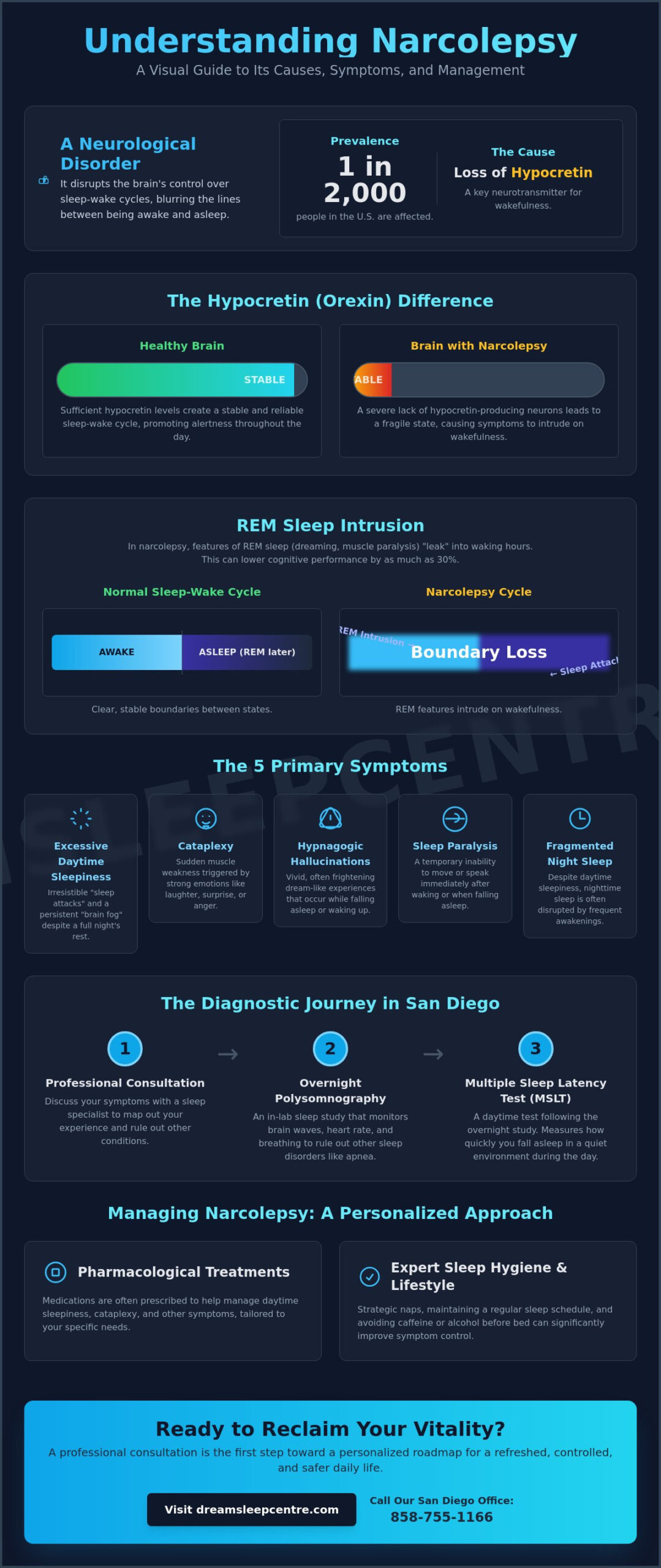
Do you find yourself struggling to stay awake during the day despite getting what feels like a full night of rest? You might be dealing with more than just simple fatigue. To define What is Narcolepsy?, we must look at it as a chronic neurological disorder that disrupts the brain’s ability to regulate sleep-wake cycles. It affects approximately 1 in 2,000 people in the United States, causing the brain to lose its boundary between being awake and being asleep.
To better understand this concept, watch this helpful video:
At the heart of this condition is a neurotransmitter called hypocretin, also known as orexin. This chemical is responsible for keeping you alert and stable throughout the day. In Type 1 narcolepsy, the brain lacks these hypocretin-producing neurons. This deficiency often results in cataplexy, a sudden loss of muscle tone triggered by strong emotions like laughter or surprise. Type 2 narcolepsy involves similar daytime sleepiness but occurs without cataplexy. According to the 2014 International Classification of Sleep Disorders, these distinctions are vital for an accurate diagnosis and treatment plan.
It’s a common mistake to assume this condition stems from psychological issues or a simple lack of sleep. This is a physical, biological reality. Our office sees patients who have been unfairly labeled as “lazy” when they are actually managing a complex brain disorder. Restoring your vitality starts with acknowledging that your symptoms have a clinical cause. You aren’t just tired; your brain’s internal clock is misfiring.
The Science of REM Intrusion
In a healthy sleep cycle, REM sleep occurs about 90 minutes after you drift off. For those with narcolepsy, REM characteristics “leak” into waking hours. This intrusion causes vivid hallucinations or sleep paralysis, which can be terrifying for the person experiencing them. This constant disruption drains your systemic health and lowers cognitive performance by as much as 30 percent in some clinical observations. It’s not just about being tired; it’s about the loss of restorative rest. If you’re ready to reclaim your days and restore your vitality, reach out to our office at 858-755-1166. Call Dream Sleep Centre today to schedule your consult and overnight sleep study.
Recognizing the Primary Symptoms: More Than Just Feeling Tired
Narcolepsy is frequently misunderstood as simple exhaustion, but the clinical reality involves a complex disruption of the brain’s sleep-wake regulation. The hallmark symptom is Excessive Daytime Sleepiness (EDS), which creates a persistent “brain fog” that doesn’t resolve with a long night of rest. For many, this manifests as sudden sleep attacks. These episodes are irresistible urges to sleep that can strike at any moment, regardless of the activity you’re performing. Understanding the Neurological Roots of Sleep Attacks is vital, as it highlights that these events are physiological, not a result of poor habits or a lack of willpower.
Beyond daytime sleepiness, many individuals experience cataplexy, a sudden loss of muscle tone. This is often triggered by strong emotions. A joke that leads to laughter or a moment of sudden anger can cause your knees to buckle or your speech to slur. While you remain fully conscious during these episodes, the temporary loss of physical control can be distressing. Other common symptoms include:
- Sleep Paralysis: A temporary inability to move or speak while falling asleep or waking up.
- Hypnagogic Hallucinations: Vivid, often frightening sensory experiences that occur at the edge of sleep.
- Fragmented Nighttime Sleep: The irony of narcolepsy is that while you struggle to stay awake during the day, your nighttime rest is often broken by frequent awakenings.
When to See a San Diego Sleep Specialist
You should consider a clinical evaluation if sleepiness interferes with your safety or professional life. If you’ve found yourself nodding off during a board meeting in Del Mar or, more critically, while navigating traffic on the I-5, these are clear signals that your health requires attention. Safety is our highest priority. We encourage you to look past the “Dream” motif of your symptoms and seek concrete medical answers. Our office provides the expertise needed to transition from constant fatigue to a state of refreshed vitality. If you are ready to reclaim your days, reach out to our office at Dream Sleep Centre. Call 858-755-1166 today to discuss your symptoms with a professional who understands the physical and emotional toll of this condition.
How Narcolepsy is Diagnosed: The MSLT and Polysomnography Process
Do you feel as though your days are a constant struggle against an invisible weight? Reclaiming your life starts with a precise understanding of your brain’s sleep architecture. Our physician-led team begins this journey by reviewing your detailed medical history and a 14-day sleep diary. While Recognizing the Primary Symptoms is a vital first step for any patient, a clinical diagnosis of narcolepsy requires objective data gathered in a controlled environment.
- Overnight Polysomnography (PSG): We first conduct an overnight polysomnography study in San Diego at our lab to monitor your heart rate, oxygen levels, and brain waves. This step is essential to rule out other disorders like sleep apnea, which affects approximately 25% of men and 10% of women, often masking the underlying causes of daytime sleepiness.
- The Multiple Sleep Latency Test (MSLT): Performed the morning after your PSG, this is the gold standard for diagnosing narcolepsy. It measures how quickly you fall asleep during five scheduled nap opportunities. Falling asleep in under eight minutes across these trials suggests a significant sleep pathology.
- Maintenance of Wakefulness Test (MWT): This test assesses your ability to stay awake in a quiet, dimly lit room. It provides our team with concrete data on your safety and alertness during typical waking hours.
The Dream Sleep Centre Experience
We’ve replaced the sterile, intimidating atmosphere of traditional hospital labs with a boutique, comfortable environment. Dr. Arani and our team believe that a relaxed patient provides the most accurate diagnostic data. Our facility uses state-of-the-art technology to track your REM cycles and physiological responses with surgical precision. You’ll find that our private suites feel more like a modern home than a medical clinic, reducing the anxiety often associated with sleep testing. If you’re tired of living in a fog, reach out to our office to book your evaluation. Call the Dream Sleep Centre at 858-755-1166 today to start your path toward clarity and health.
Managing Narcolepsy: Personalized Care Plans in San Diego
Living with narcolepsy requires more than just willpower; it necessitates a structured, clinical strategy to regain control over your wakefulness. Our approach focuses on stabilizing your symptoms through a combination of medical expertise and daily habits. Because every patient’s neurochemistry is unique, we prioritize personalized care plans that evolve with your specific needs.
Pharmacological treatments serve as a cornerstone for many individuals. Physicians often utilize stimulants to promote daytime alertness and REM-suppressing medications to manage cataplexy or sleep paralysis. Clinical data suggests that approximately 90% of patients with narcolepsy experience a measurable reduction in sudden sleep attacks when adhering to a consistent, physician-led medication regimen. These treatments are most effective when they’re integrated into a broader wellness framework that addresses both physical and emotional health.
Lifestyle adjustments act as powerful therapeutic tools that complement medical intervention. We recommend several practical steps to help manage your daily energy levels:
- Scheduled Naps: Brief, 20 minute naps taken at strategic times during the day can significantly reduce heavy daytime sleepiness.
- Strict Sleep Hygiene: Maintaining a consistent wake-up time seven days a week helps regulate the body’s internal clock and improves nighttime sleep quality.
- Dietary Awareness: Avoiding heavy, carbohydrate-rich meals during the day can help prevent the post-meal energy crashes that often trigger sleep episodes.
Dream Sleep Centre stands as your dedicated local partner for ongoing monitoring and support. We emphasize a non-surgical, physician-led approach to long-term management. This ensures your treatment remains safe and effective while minimizing the physical toll that chronic sleep deprivation takes on your vitality. For patients whose nighttime sleep difficulties are compounded by anxiety or conditioned wakefulness, our team may also recommend exploring CBT-I in San Diego as a drug-free approach to recalibrating the brain’s sleep-wake drive. Our team focuses on providing a smooth, frictionless experience that moves you toward a life of quiet stability and refreshed mornings.
Taking the First Step Toward Restorative Rest
You don’t have to manage the complexities of narcolepsy alone. Our team is ready to help you navigate your path to better health and renewed energy. Reach out to our office to book a consultation at our San Diego or Hillcrest locations. Call 858-755-1166 today to start your journey toward a more refreshed and alert future. We’re here to ensure you’re in safe, expert hands every step of the way.
Reclaiming Your Days with Expert Sleep Care
Living with narcolepsy means navigating a world where sudden sleep attacks and persistent daytime fatigue disrupt your personal and professional life. Recognizing that these symptoms stem from complex neurological roots is the first step toward regaining your independence. At Dream Sleep Centre, our process prioritizes a precise diagnosis through advanced MSLT and polysomnography testing in San Diego conducted in our state-of-the-art boutique sleep labs. This clinical data allows us to move beyond general advice and toward a solution that addresses your unique physiological needs.
Under the expert guidance of Dr. Ramadevi Arani, MD, we provide comprehensive, non-surgical personalized treatment plans that focus on long-term wellness. You don’t have to settle for a life defined by exhaustion. If you’re struggling with sudden sleep attacks, reach out to our San Diego office today or call 858-755-1166 to schedule your evaluation. We’re dedicated to helping you bridge the gap between clinical science and personal well-being. Your journey toward a vibrant life starts with a professional consultation. We look forward to helping you rediscover the quiet confidence that comes from truly restorative rest.
Frequently Asked Questions
Is narcolepsy a permanent condition or can it be cured?
Narcolepsy is a chronic, lifelong neurological condition that currently has no known cure. It typically involves the loss of approximately 90% of the neurons that produce hypocretin, the chemical responsible for keeping you awake. While the condition is permanent, our office focuses on restoring your vitality through advanced management. You don’t have to navigate this journey alone. Call Dream Sleep Centre at 858-755-1166 today to start your path toward more restful days.
Can I still drive in San Diego if I have been diagnosed with narcolepsy?
You can drive in San Diego after a diagnosis, but California law requires physicians to report disorders characterized by lapses of consciousness to the DMV. Your ability to keep your license depends on how well your symptoms are controlled, often requiring a 6 month period without a sleep episode. We prioritize your safety and independence. If you’re worried about daytime fatigue, reach out to our office to discuss how we can help you stay refreshed.
What is the difference between narcolepsy and idiopathic hypersomnia?
The primary difference lies in the timing of REM sleep during your diagnostic testing. Patients with narcolepsy often enter REM sleep within 15 minutes of falling asleep, whereas those with idiopathic hypersomnia do not. While both conditions cause extreme daytime sleepiness, idiopathic hypersomnia often involves sleeping more than 10 hours without feeling refreshed. Our specialists use precise diagnostics to ensure you receive the correct care. Call 858-755-1166 to schedule your consultation.
Does health insurance in California typically cover narcolepsy testing?
Most health insurance plans in California, including Blue Shield and Medicare, cover diagnostic testing when a physician documents medical necessity. These procedures are essential for identifying the root of your exhaustion and developing a treatment plan. You’ll likely need a prior authorization before your overnight sleep study. Our team is here to help you navigate the insurance process so you can focus on your health. Reach out to our office today to begin the process.
How long does a Multiple Sleep Latency Test (MSLT) take?
A Multiple Sleep Latency Test typically takes about 7 to 8 hours to complete during the day. This test involves 5 scheduled nap opportunities, each spaced 2 hours apart, to measure how quickly you fall asleep in a quiet environment. It’s usually performed immediately following an overnight sleep study to provide a complete picture of your sleep health. If you’re ready for answers, call 858-755-1166 today to schedule your evaluation at Dream Sleep Centre.
Disclaimer
The information provided by Dream Sleep Centre is for educational and informational purposes only and does not constitute medical advice, diagnosis, or treatment. Always seek the advice of your physician or other qualified health provider with any questions you may have regarding a medical condition or sleep disorder. Never disregard professional medical advice or delay in seeking it because of something you have read on this website. Reliance on any information provided here is solely at your own risk.