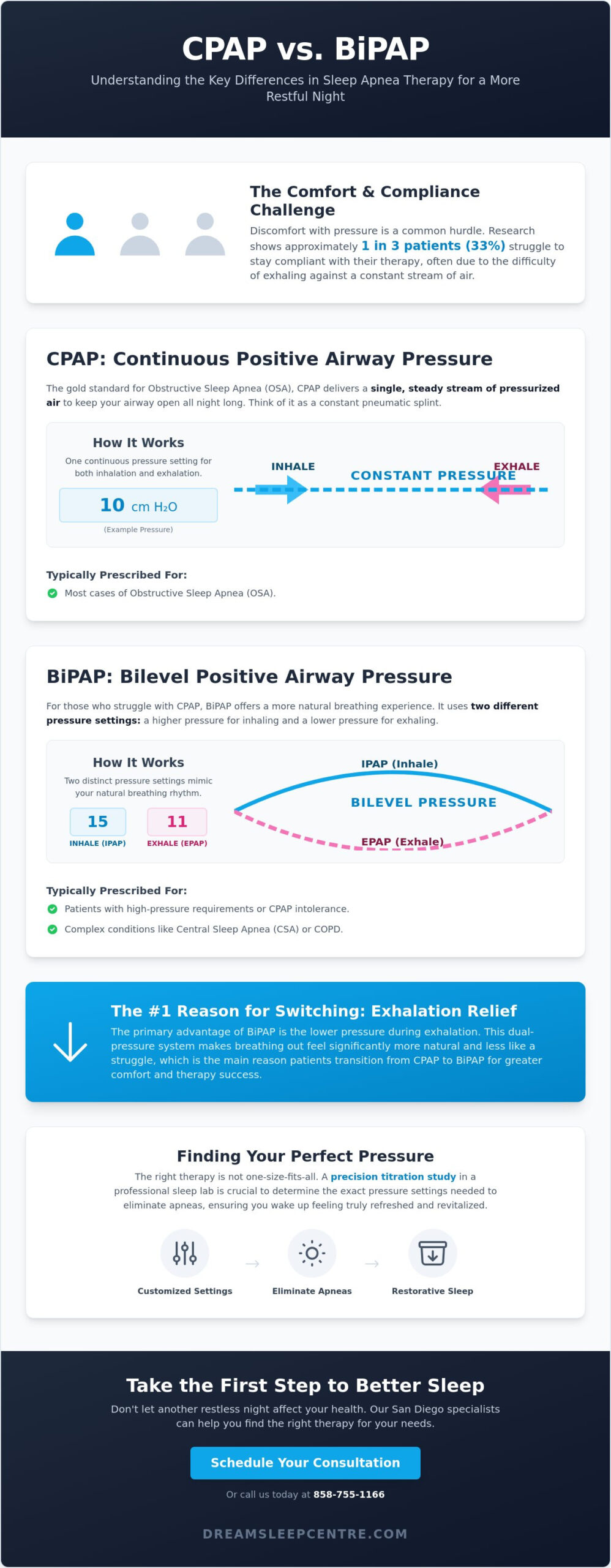
What if the machine designed to save your sleep is actually the thing keeping you awake? If you’ve spent your nights struggling to exhale against a forceful stream of air, you aren’t alone. Research published in the Journal of Clinical Sleep Medicine indicates that roughly 33% of patients find it difficult to stay compliant with therapy because of this specific pressure discomfort. Understanding the technical difference between cpap and bipap is the first step toward reclaiming your energy. You deserve to wake up feeling refreshed rather than battling a device for every breath.
We recognize that complex medical terminology can feel overwhelming when you’re already drained by persistent daytime fatigue. Our office is here to provide the clinical expertise you need with the compassion you deserve. You’ll discover how tailored pressure settings can transform your sleep experience and whether you’re a candidate for BiPAP therapy. At Dream Sleep Centre, we focus on restoring your vitality through precise, professional care. Don’t let another restless night affect your health. Call our San Diego specialists at 858-755-1166 today to schedule your consultation and begin your path to the quiet, restorative dream sleep you’ve been missing.
Key Takeaways
- Understand how the steady stream of CPAP compares to the dual-pressure relief of BiPAP to identify the path toward your most restful sleep.
- Learn why exhalation relief is the primary reason patients visit our Hillcrest office to transition toward a more comfortable and natural breathing experience.
- Discover the clinical difference between cpap and bipap to determine which therapy is necessary for treating complex conditions like Central Sleep Apnea or COPD.
- Explore how a precision titration study in our boutique San Diego lab can eliminate apneas and help you wake up feeling truly refreshed and revitalized.
- Take a proactive step toward better health by contacting Dream Sleep Centre at 858-755-1166 to schedule your professional sleep evaluation today.
Defining CPAP and BiPAP for San Diego Patients
Are you waking up feeling exhausted despite spending eight hours in bed? For many in our San Diego community, the struggle with sleep-disordered breathing is a daily reality that drains your vitality and health. Understanding the mechanics of Continuous positive airway pressure (CPAP) is the first step toward reclaiming your rest. While both devices are non-invasive and vital for keeping your airway open, the primary difference between cpap and bipap lies in how they deliver that life-giving air to your lungs. BiPAP is a ‘bilevel’ solution that mimics natural breathing patterns more closely than standard CPAP.
To better understand this concept, watch this helpful video:
How CPAP Supports Your Airway
CPAP is widely considered the gold standard and first line of defense for obstructive sleep apnea (OSA). It works by delivering a single, steady stream of pressurized air that acts as a pneumatic splint. This constant pressure prevents your soft tissues from collapsing, which the American Academy of Sleep Medicine notes can occur 30 times or more per hour in severe cases. By maintaining a clear passage, you can finally achieve the deep, restorative sleep your body requires to function.
How BiPAP Enhances Breathing Comfort
If you find it difficult to exhale against a constant stream of air, BiPAP offers a more tailored experience. This technology utilizes two distinct pressure settings: Inspiratory Positive Airway Pressure (IPAP) for when you breathe in, and a lower Expiratory Positive Airway Pressure (EPAP) for when you breathe out. This pressure drop during exhalation reduces the suffocating feeling some patients experience with standard machines. It is a sophisticated way to address the difference between cpap and bipap for those with specific respiratory needs or high-pressure requirements.
If you are struggling with your current equipment or suspect you have sleep apnea, reach out to our office at 858-755-1166. Call Dream Sleep Centre today to schedule your consult and start your journey toward refreshed mornings and quiet, peaceful nights.
The Primary Differences: Pressure Delivery and Breathing Mechanics
The core difference between cpap and bipap lies in how the machine manages airflow during your sleep cycle. A Continuous Positive Airway Pressure (CPAP) machine delivers a single, steady stream of air at one constant pressure setting. This keeps your airway open throughout the night, but it requires you to exhale against that same incoming force. According to a clinical review of CPAP therapy, this constant pneumatic splinting is the gold standard for most patients, yet it does not always account for the natural rhythm of your lungs. Understanding the technical difference between cpap and bipap helps you advocate for your own comfort when a standard setup feels restrictive.
This dual-pressure system used by Bi-level Positive Airway Pressure (BiPAP) devices utilizes a more complex internal algorithm. It provides two distinct pressures: a higher level for inhalation and a lower level for exhalation. At our Hillcrest office, we have found that this dual-pressure system is often the key to long-term compliance for those who feel like they are fighting the machine to get a full breath.
Pressure Settings and Customization
A typical CPAP might be set at a fixed 10 cm H2O. You feel that 10 cm H2O whether you are breathing in or out. BiPAP allows for a “pressure support” gap, perhaps 15 cm H2O to inhale and 11 cm H2O to exhale. This customization makes the therapy feel more like natural breathing. Choosing the right types of cpap masks is also vital, as the mask interface determines how you perceive this pressure shift against your skin and affects the overall seal.
The Exhalation Challenge
The #1 reason patients switch to BiPAP in our San Diego clinic is exhalation relief. When your prescribed pressure exceeds 15 cm H2O, the “work of breathing” increases significantly. It can feel like trying to blow air into a high-speed fan, which leads to anxiety and mask removal during the night. This technology reduces the effort required to breathe out, making it a superior choice for patients with complex needs or those who experience high-pressure intolerance. If you find yourself struggling to breathe out, it is time to consult with a specialist about your settings.
Are you waking up feeling exhausted despite using your machine? Our team at Dream Sleep Centre can help you find the right balance for restorative rest. Call 858-755-1166 today to schedule your consultation and take the first step toward a quiet, refreshed morning.
Clinical Indications: When is BiPAP Necessary Over CPAP?
Many patients mistakenly believe a BiPAP machine is simply a “luxury” or “premium” version of a CPAP. This isn’t the case. The difference between cpap and bipap is rooted in clinical necessity rather than comfort features. While CPAP provides a single, steady stream of air, BiPAP is a specialized medical intervention for those whose bodies require more complex respiratory support. If you’ve found it difficult to exhale against the constant pressure of a standard machine, our office can help determine if a different approach is required for your specific condition.
Complex Sleep Apnea and Central Apnea
Central Sleep Apnea (CSA) occurs when the brain fails to send the proper signals to the muscles that control breathing. Unlike obstructive apnea, where the airway is physically blocked, CSA is a neurological disconnect. BiPAP machines are often the gold standard here because they include a “timed” feature. This setting monitors your breathing frequency; if you don’t take a breath within a set number of seconds, the device initiates one for you. Getting a precise diagnosis at a dedicated sleep medicine center is the only way to identify if your apnea requires this advanced backup rate.
Respiratory and Cardiovascular Considerations
Patients with underlying health issues like COPD or congestive heart failure often struggle with high carbon dioxide retention. For these individuals, the dual-pressure system of BiPAP is essential. By lowering the pressure during exhalation, the device makes it easier for the body to vent CO2 and take in oxygen without overworking the heart. We view sleep health as a pillar of systemic vitality. If you’ve failed traditional therapy, we may recommend BiPAP as one of the alternatives to cpap to ensure your cardiovascular system isn’t under stress while you rest.
Your path to restorative sleep starts with an expert evaluation. Call Dream Sleep Centre at 858-755-1166 today to schedule your consultation and find the right solution for your needs.
Titration and Testing at Our San Diego Sleep Lab
Finding the precise pressure to resolve your sleep apnea is a delicate science that requires clinical expertise. At Dream Sleep Centre, we perform CPAP titration studies to identify the exact settings that eliminate your airway obstructions without disrupting your sleep. While understanding the difference between cpap and bipap is a great first step, the titration process provides the data needed to determine which technology suits your unique physiology.
Our boutique lab in San Diego offers a home-like environment designed to reduce the anxiety of clinical testing. During your overnight evaluation, our specialists monitor your brain waves, heart rate, and oxygen levels. This comprehensive data allows us to calibrate your machine perfectly. It’s the most effective way to ensure your therapy feels natural and restorative rather than intrusive, helping you reclaim your vitality.
What to Expect During a Titration Study
The process begins with the machine set to a very low pressure. As you fall into different stages of sleep, our technicians gradually increase the airflow until your snoring and apneas stop. This incremental approach ensures your comfort and prevents the sensation of being overwhelmed by air. For a detailed preparation checklist, read our guide on the in hospital sleep study to feel fully prepared for your visit.
Your Path to Restorative Sleep in San Diego
Dr. Arani and our dedicated team analyze every data point from your titration to select the right device for your lifestyle. We don’t just hand you a machine and send you on your way. Our commitment to your long-term wellness includes consistent follow-up care to ensure your mask fits comfortably and your settings remain optimal as your health evolves. This precision is why the difference between cpap and bipap matters so much for your specific treatment plan.
Don’t let another night of exhaustion affect your quality of life. Call our office today at 858-755-1166 to schedule your consultation and take the first step toward restorative rest.
Reclaim Your Vitality Through Restorative Sleep
Are you tired of waking up exhausted? Finding the right solution starts with understanding the technical difference between cpap and bipap machines. While CPAP delivers a single steady stream of air, BiPAP adjusts to your natural rhythm by lowering pressure when you exhale. Our team uses state-of-the-art diagnostic technology at our Hillcrest facility to determine which method fits your unique physiology. Under the expert guidance of Dr. Ramadevi Arani, MD, we move beyond generic treatments to provide a boutique, comfortable sleep study environment that prioritizes your peace of mind.
You don’t have to navigate these complex medical choices alone. Whether you need a precise titration or a more comfortable, travel-friendly alternative, our physician-led team is here to help you achieve the quiet, refreshed state you deserve. Reach out to our office to begin your journey toward better systemic health and lasting wellness.
Ready to find the right sleep solution? Schedule your consultation at Dream Sleep Centre in San Diego today or call us at 858-755-1166. We look forward to helping you finally get the restorative rest you’ve been dreaming of.
Frequently Asked Questions
Is a BiPAP machine better than a CPAP for obstructive sleep apnea?
The primary difference between cpap and bipap lies in the pressure delivery; a BiPAP machine isn’t inherently better, but it serves a distinct clinical purpose for specific patients. While a CPAP provides a constant stream of air, a BiPAP offers two separate pressures for inhalation and exhalation. This dual-pressure system is often necessary for the 15 percent of patients who struggle with the high fixed pressure of a standard CPAP. At Dream Sleep Centre, our goal is to find the specific therapy that restores your vitality.
Can I switch from CPAP to BiPAP if I find it hard to breathe out?
You can switch to a BiPAP if you experience discomfort while exhaling against the continuous pressure of a CPAP. Understanding the difference between cpap and bipap is crucial when you feel like you’re fighting your equipment. If your current settings feel restrictive, it’s time to consult with our experts. We help you transition to a more comfortable breathing rhythm so you can wake up feeling refreshed rather than exhausted by your treatment.
Does insurance in California typically cover BiPAP machines?
Most insurance providers in California, including major carriers like Blue Shield or Kaiser Permanente, cover BiPAP machines when medical necessity is documented. Usually, this requires proof that a patient failed to tolerate CPAP therapy or has a specific condition like central sleep apnea. Our office can help you navigate these requirements to ensure your path to better health is smooth. Call 858-755-1166 today to discuss how we can assist with your documentation and insurance coordination.
Is a BiPAP machine louder than a standard CPAP device?
Modern BiPAP machines are designed to be exceptionally quiet, typically operating at sound levels between 26 and 30 decibels. This is roughly the same volume as a soft whisper or a rustling leaf, ensuring your sleep environment remains peaceful. While the motor might change pitch slightly as it shifts between inhalation and exhalation pressures, it shouldn’t disrupt your partner’s rest. If your device exceeds these sound levels, it may need professional servicing or a filter replacement.
How do I know if I need a new sleep study to change my machine?
You generally need a new sleep study if your previous results are more than five years old or if you’ve experienced a weight change of 10 percent or more. A fresh titration study allows us to determine the exact pressure settings needed to treat your apnea effectively. This data is vital for a successful transition and is often required by medical guidelines. Reach out to our office at 858-755-1166 to schedule your consultation and reclaim your quiet, restful nights.
Disclaimer
The information provided by Dream Sleep Centre is for educational and informational purposes only and does not constitute medical advice, diagnosis, or treatment. Always seek the advice of your physician or other qualified health provider with any questions you may have regarding a medical condition or sleep disorder. Never disregard professional medical advice or delay in seeking it because of something you have read on this website. Reliance on any information provided here is solely at your own risk.